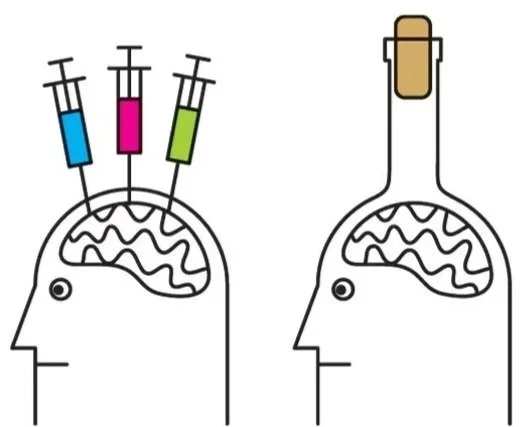
Why are drugs addictive?

Addictiveness or, better, dependence forming potential comes down to the question of ‘What is it about the drug that makes me want to use it again and to keep on using it even in the face of negative consequences?’ The connections between the pharmacology of drugs and the psychological consequences are the essence of addictive behaviours.
If drugs have a psychoactive effect then they are potentially addictive. Craving or feeling the need for a psychoactive drug, or even believing in the need, is unlike needing a medicine such as insulin.
What are the pharmacological properties of psychoactive drugs that make them addictive?
There are four properties of psychoactive drugs that contribute to its dependence forming potential, that creates the urge to keep on taking the drug. In psychology this is called reinforcement.
✔︎ Potency
The stronger the drug effect the more reinforcing
The faster the drug effect occurs the more reinforcing
The more quickly the drug effect wears off the sooner the desire to 'top up' occurs; avoiding loss of the drug effect is called negative reinforcement
✔︎ Plasticity
When the drug effect is moulded by the environment in an unpredictable way, it is less reinforcing.
Key concept…
potency of effect
Psychology tells us that if we like doing something we are likely to do it again. The more we like it, the more we want to do it.
Potency is defined as the amount of a drug required to produce a given effect. Potency depends on both the affinity and efficacy of the drug. Affinity is how strongly a drug binds to its receptor and efficacy is the size of response, that is, the drug effect.
In this example the chart shows how three drugs that all have a strong affinity for opioid receptors have quite different effects.
Naltrexone blocks the receptor, methadone has a full opiate effect, buprenorphine has a partial effect.
In this second example the chart illustrates how drugs that all have a strong affinity for opioid receptors have quite different effect sizes.
Key concept…
speed of onset of effect
Psychology tells us that the sooner the consequences of drink or drugs occur, the more impact they have.
The addictive potential is a function of the speed of onset of a drug effect. This can be demonstrated by looking at drugs that have the same kind of effect eg heroin is more addictive than morphine and diazepam is more addictive than oxazepam.
Speed of onset of a drug effect is also determined by the way that it is taken. Drugs that are smoked or taken intravenously will have a more rapid onset of effect than when taken by mouth. Taking the example of cocaine, the chart illustrates how different routes of use have quite different effect sizes.
Key concept…
duration of effect
When the effect of a drug starts to wear off then there may be a desire to top up. The shorter acting the drug the sooner the craving and the need to top up comes around and so the more addictive the drug.
The need to top up is driven by...
i) wanting to keep the drug effect going
ii) wanting to relieve/avoid withdrawal symptoms, or both of these.
The chart shows how drugs are eliminated from the body and so how the drug effect is lost.
Notice alcohol is eliminated at a constant rate. Most drugs are like heroin where the more drug is taken the faster it is broken down so that heroin is totally removed from the body in a fixed time regardless of how much was taken.
Notice that, for heroin but not alcohol, the blood level falls steeply initially. The time taken to reduce the plasma (blood) concentration by 50% is called its half-life (t½). A drug is totally eliminated after 5-6 half-lives.
Although we think in terms of how long it takes for the drug to be removed from the body, many drugs are broken down in the body to make new substances called metabolites. This is important to know when testing for drugs. Heroin, diazepam and cocaine are examples. Metabolites may have more or less potent psychoactive effects.
Key concept…
plasticity of effect
The effects of some drugs are shaped by the circumstances in which they are taken. Recreational drugs tend to have fairly but not totally predictable effects. The more predictable the more addictive.
The predictability of a drug is called its plasticity. The more plastic a drug the more effects are influenced by i) a person’s mental set eg feeling anxious or depressed, expecting a particular drug effect, feeling safe and ii) the setting eg with friends or strangers, in a comfortable place, the familiarity of the location, are the key influences. People tend to prefer drugs with some plasticity but not too much...
Low plasticity drugs have pretty much the same effect when or where they are taken
eg heroin, cocaine, nicotine, amphetamine
Mid plasticity drugs have some variability in their effects depending on the situation
eg alcohol, cannabis

High plasticity drug effects are not so much unpredictable as variable given the situation
eg LSD, solvents, ketamine

Applying the addictive potential criteria…
See what happens if we apply all four addictive potential criteria to six commonly used substances.
How well does this tally with your expectations?
Examples of applying these ‘addictiveness’ criteria
Professor Adam Winstock has used similar criteria to estimate the addictive potential of a whole range of drugs.
Chart reproduced by permission of Prof. Winstock.
Click chart to enlarge
Pharmacokinetics of opioids
This video by Medmastery explains why the kinetic properties of the same class of drug, in this case opioids, changes their addictiveness.
Watch the YouTube video ►
more about addiction…