
Is minimum pricing the best way to reduce alcohol consumption?
On the t-shirt you will find the motion for the debate, and below it, arguments for and against.
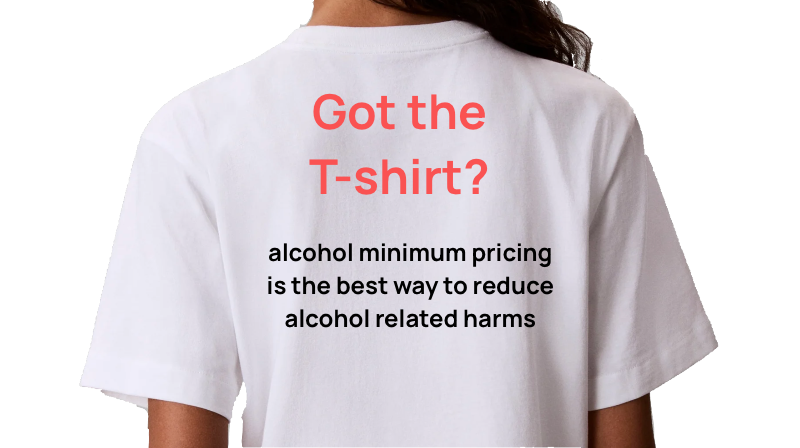
Are you for or against or not sure?
For... There is a lot of evidence on how minimum pricing works to reduce alcohol consumption in the whole population. It is a policy that can easily be adjusted by politicians as needed and it makes clear to the drinks industry that they will not be allowed to sell whatever products they like to the public.
Against... It is counter to basic freedoms to impose an alcohol policy that affects everybody when it is only a small proportion of drinkers who have any problems. The best solution is a medication so that individuals with a problem can control their own alcohol consumption and take responsibility for their health and wellbeing.
Here is something to inform your thinking…
Read the summaries of these studies: These summaries of two research articles cited below should help you clarify your thoughts on the issues raised by the debate… These articles are not intended to be compared directly, rather they point to two ways of achieving the same goal, namely a reduction in alcohol consumption. On the one hand a relatively inexpensive medication becomes costly when applied at a population level, on the other hand a social policy is going to affect everybody. Is there a preferred approach?
Minimum alcohol unit pricing policy Since May 1, 2018, every alcoholic drink sold in Scotland has had minimum unit pricing (MUP) of £0·50 per unit - Canada, Australia, Ireland have similar policies. Hospital admissions wholly attributable to alcohol reduced by 4.1%, and deaths by 13.4%. Hospitalisations for alcohol dependence increased 7.2% and intoxication 3.9%. The most disadvantaged people benefit most from minimum pricing. Alcohol deaths reduced 17-33% and hospitalisations 4-7% in the four most deprived groups. Nalmefene - indicated for heavy drinkers A real-life study of nalmefene prescribing in France reports on 1year outcomes for 256 of 700 people newly prescribed nalmefene in routine practice - 46% in primary care. Reduction from baseline averaged 41.5gm/day (sd 57.4) and heavy drinking days by 10.7days/month (sd 11.7). At 1month 5% discontinued medication, 52% at 1year. Other studies have shown nalmefene is cost-effective and significantly reduces adverse alcohol related diseases and deaths.
Get the full text of the article
Aubin H-J, Dureau-Pournin C, Falissard B, Paille F, Rigaud A, Micon S, Pénichon M, Andersohn F, Truchi C, and Blin P on behalf of the USE-PACT study group (2021) Use of Nalmefene in Routine Practice: Results from a French Prospective Cohort Study and a National Database Analysis.Alcohol and Alcoholism 56: 545–555 doi.org/10.1093/alcalc/agab029
Get the full text of the article
Wyper GMA, Mackay DF, Fraser C, Lewsey J, Robinson M, Beeston C et al (2023) Evaluating the impact of alcohol minimum unit pricing on deaths and hospitalisations in Scotland: a controlled interrupted time series study. The Lancet 401: 1361-1370 doi.org/10.1016/S0140-6736(23)00497-X
Have you looked at the Alcohol Harms section of the What is Addiction? page?