
Are drug consumption rooms an effective harm reduction strategy?
On the t-shirt you will find the motion for the debate, and below it, arguments for and against.
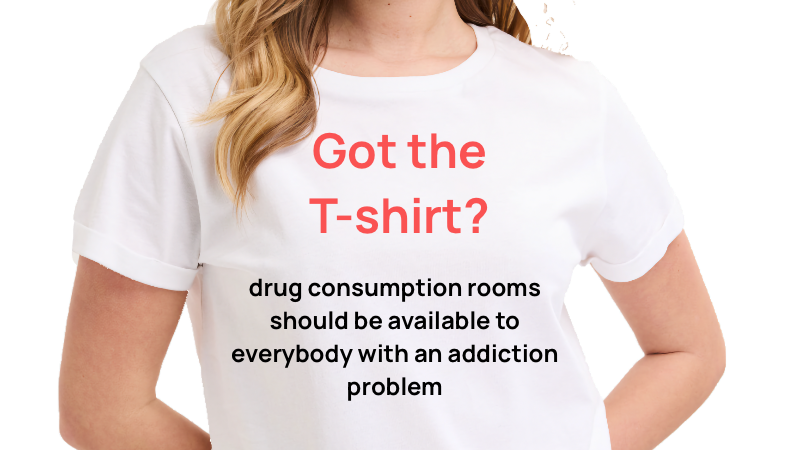
Are you for or against or not sure?
For... Drug consumption rooms are a form of harm reduction and harm reduction is important at all stages of the recovery journey. To be able to take drugs in a safe environment, especially if there is also some access to basic health care, is a significant step in preventing serious consequences and costs from drug use.
Against... Providing drug users with a safe place to take drugs and some guidance on using safely makes motivating people to change more difficult. The general public object to tax-payers' money being spent on expensive units which are seen to encourage continued drug use and drug dealing around the facility.
Here is something to inform your thinking…
Read the summary of this article: Any discussion of substance use related harms begs the question ‘Can the harm be reduced?’ Harm reduction tends to be controversial because the balance between the benefits and the disadvantages is often unclear. Read the article cited below, which reviews the evidence for supervised injecting facilities and drug consumption rooms and see what general principles for judging a harm reduction strategy you can draw out.
The researchers report on i) drug-related harms, ii) access to substance use treatment and other health services, iii) impact on the local drug injecting population, iv) impact on public drug use, drug-related crime and violence. There has not been a cost-effectiveness analysis.
Health outcomes from a 5yr perspective A 35% decrease in ambulance attendances for opioid related problems (there was a general decrease in the area but not so marked). An increase from 38% to 61% experiencing an overdose, and a 7% increase in those injecting daily. 32% more engaged with drug treatment services and 40% more with primary health care. 48% were getting health care for the first time. 77% had at least one period of stopping injecting.
Community outcomes from a 5yr perspective Witnessing injecting in the community was reported down from 33% to 19% by local residents and 38% to 28% for businesses. There was a corresponding reduction in discarded drug use paraphernalia but no reduction in the offers to buy street drugs.
Get the full text of the article
Tran V, Reid SE, Roxburgh A and Day CA (2021) Assessing Drug Consumption Rooms and Longer Term (5 Year) Impacts on Community and Clients.Risk Management and Healthcare Policy 14: 4639-4647 doi.org/10.2147/RMHP.S244720
Have you looked at the Injecting Harms section of the What is Addiction? page?