
How much treatment time is used up with chat?
On the t-shirt you will find the motion for the debate, and below it, arguments for and against.
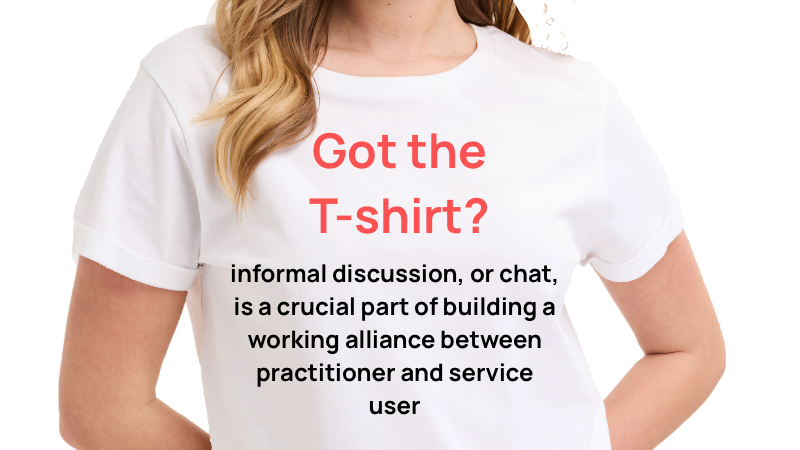
Are you for or against or not sure?
For... Talking about things that are neutral and do not cause anxiety for a service user is important, especially in the early stages of an intervention, in order to create a trusting relationship and to break down any barriers that might exist. Without chat practitioners appear distant and can be felt as looking down on their service user.
Against... Beyond initial introductions, informal discussion is a waste of therapy time. It is important to stick to treatment protocols that are associated with change. It is quite possible that service users and practitioners have different views on all kinds of issues and irrelevant chat can be felt as showing disinterest in a service user’s problems.
Here is something to inform your thinking…
Read the summary of this articleabout chat: The value of informal discussion within treatment sessions has long been debated. Practitioners talking about personal reactions or experiences that are similar to their service user’s is seen as potentially beneficial in that it helps practitioners convey genuineness, authentic concern and build a working alliance. This kind of self-disclosure is fundamental to the working of twelve step groups. On the other hand, talking about things that are not immediately related to a service user’s treatment may appear insensitive or irrelevant and thereby undermine the therapeutic alliance and waste time.
In this study 41 practitioners were trained to use motivational techniques and 35 delivered ‘counselling as usual’; 736 treatment sessions were tape recorded. Most irrelevant chat involved disclosures of personal information (28%) such as common interests e.g., pets, vacation preferences, activities (e.g., exercise, shopping), background e.g., ethnicity, religion, and experiences with family and friends. Practitioners also disclosed their own prior history of health problems (7%) or psychological and interpersonal difficulties (6%) and offered their unsolicited opinion (22%) about many different topics e.g., the quality of restaurants, other treatment providers, current events or news (9%), work-related problems or stressors (6%), and their professional background or history (3%). Informal discussion, or chat, was negatively associated with in-session change in motivation to reduce or stop using drugs and alcohol even though it may increase the feeling of friendship between practitioner and service user.
Get the full text of the article
Martino S, Ball SA, Nich C, Frankforter TL and Carroll KM (2009) Informal Discussions in Substance Abuse Treatment Sessions. J Substance Abuse Treatment 36: 366–375 doi:10.1016/j.jsat.2008.08.003
Have you looked at the Motivational Dialogue and Motivational Dialogue Research pages?