
Who is best placed to deliver brief interventions?
On the t-shirt you will find the motion for the debate, and below it, arguments for and against.
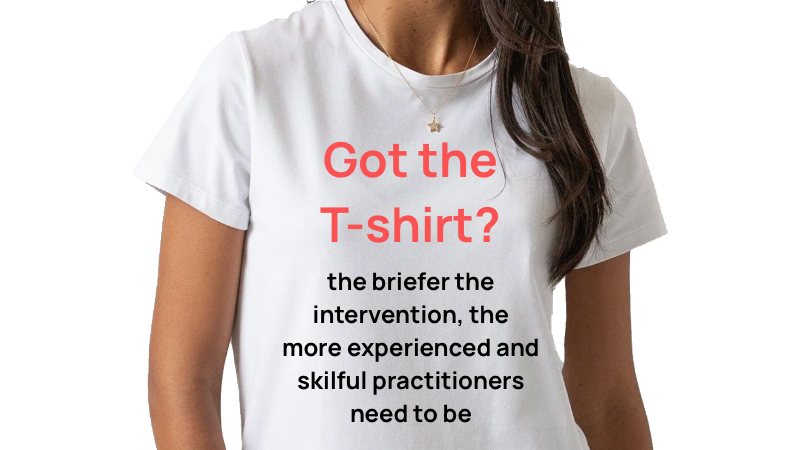
Are you for or against or not sure?
For... Effective delivery of brief interventions requires that practitioners have the ability quickly to assess a person’s ‘stage of change’ or motivation and make an accurate reflection to have the best chance of facilitating change. It takes an experienced practitioner to make a quick assessment of what to do.
Against... The majority of people with alcohol and drug problems do not visit specialist addiction services but are in contact with all sorts of other services such as general practices, pharmacies, dentists, ante-natal services. The use of brief interventions can easily be taught to these staff and they are highly effective in these settings.
Here is something to inform your thinking…
Have a look at the suggested pages of this report: This WHO report should help you clarify your thoughts on the issues raised by the debate. The point to be made here is that some people will move on from their addiction with only brief contact with professional help; these are most likely people who are already motivated to change and have the social capital that they need.
Things do not always work out as expected and, as ever, therapists need to be alert to how well their intervention is going and be flexible in response. It is best not to get bogged down with definitions, rather understand the principles. Browse the WHO alcohol brief intervention training manual for primary care. The content refers to alcohol brief interventions but the same approach can be applied to drugs in most circumstances. This is a really excellent training guide - how much detail you want to read will depend on your role. Everybody can benefit from looking at these sections: pp2-6 What are brief interventions; pp50-52 Practitioner concerns about their role; pp53-56 Beginning a conversation; pp57-66 Screening and feedback using the AUDIT and pp70-73 Eliciting change talk.
Get the full text of the article
WHO alcohol brief intervention training manual for primary care
Have you looked at the Effective Interventions page?