
What is the best way to create rapport?
On the t-shirt you will find the motion for the debate, and below it, arguments for and against.
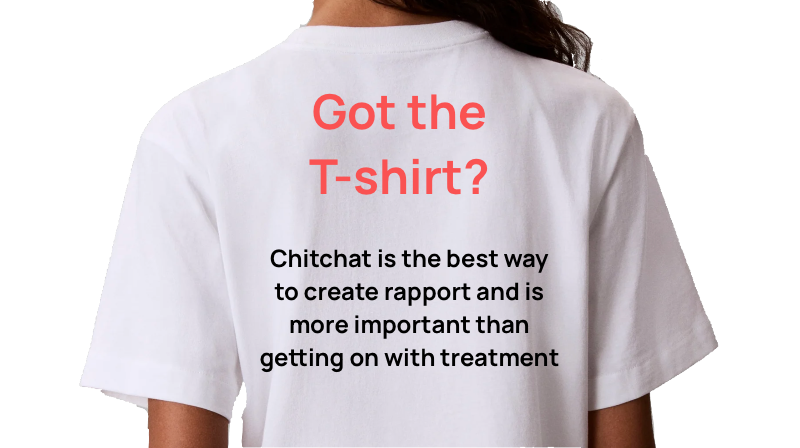
Are you for or against or not sure?
For... Chitchat is the best way to establish rapport and essential before you can talk about any addiction problem and its treatment. If there is no rapport then there is no point to any kind of intervention; service users will not take in anything that is said to them, they will probably dislike their practitioner, and are likely to drop out.
Against... Practitioners and service users do not necessarily share the same cultural background and chitchat can look like fake friendliness; it can also become an end in itself. Service users come to get help with a problem and rapport is best established by getting on with a friendly, empathic discussion of how to help.
Here is something to inform your thinking…
Read this summary of an article by an A&E doctor: The question here is whether building rapport is enough. Of course, it is important but so is getting on with some form of intervention. The point is illustrated in the short article by a young doctor in training, cited below. He talks about his experience during the COVID pandemic when, for a variety of reasons, it was proving difficult to establish rapport with people being admitted to hospital with a life-threatening illness.
In all the busy hospital departments during the COVID pandemic it was crucial to get on with essential treatments, but it was also important to establish rapport and try to put at ease people who were experiencing distressing and potentially life-threatening symptoms. It is important to experiment with what works for the practitioner’s style and what is acceptable to the huge mix of service users.
The key challenge of rapport building is posed by the sheer diversity of service users.
Building effective rapport improves compliance with treatment, satisfaction, and overall outcome.
In a busy department there is no time to 'talk about the weather' and so you have to establish rapport quickly as part of getting on with the care programme.
Get the full text of the article
Butt MF (2021) Clinical Medicine 21: e662–3 10.7861/clinmed.2021-0264
Have you looked at the Helpful People and Helpful People Research pages?