
Is the stigma attached to personality disorder inevitable?
On the t-shirt you will find the motion for the debate, and below it, arguments for and against.
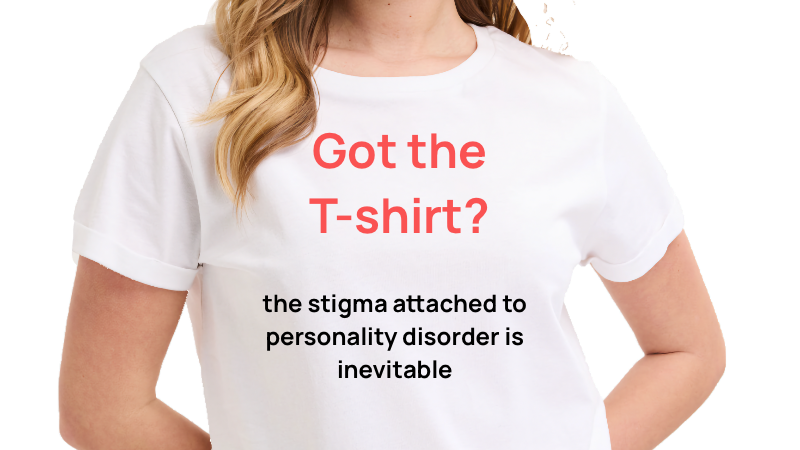
Are you for or against or not sure?
For... There is a low level of understanding of personality disorder in the general population and this results in mislabelling and negatively labelling its features. There is also a perception that there is no effective treatment for personality disorder, which is indeed often manifest in behaviours that are socially disruptive.
Against... The general population tend to stigmatise any form of mental or physical health problem. The more overt, the greater the stigma. One of the ways to address stigma, not least for personality disorders, is to familiarise the public with the help that can be given and how friends and family can better manage the problem.
Here is something to inform your thinking…
Read the summary of this article on psychiatric literacy: The place of personality disorder and its treatment have been debated in the psychiatric literature and in the politics of provision. Low levels of knowledge of the variety of conditions and their management mean help is not often sought, and not often forthcoming. This article reports research that gets at the root of these problems and suggests some ways forward. The researchers report on a study of the levels of knowledge about personality disorder in a “convenience sample” of 223 lay people. The nature of the sample means it was quite biased towards students (60%) and a more literate sub-sample of the general population. A questionnaire entitled ‘eccentric people’ contained vignettes of 10 personality disorders which were to be rated as well as labelled. The researchers found that lay people recognise people with personality disorders as being unhappy, unsuccessful at work and as having poor personal relationships, but do not associate these problems with psychological causes.
The level of knowledge in the general population is low Different personality disorder types were differentially recognised and understood. With the exception of 3 personality disorders, the correct identification (applying the correct label) rate for the personality disorders was very low, below 7%. Paranoid and obsessive compulsive disorders were more often correctly labelled than the others. The labels of depression, autism spectrum disorder and low self-esteem were most likely to be erroneously used. A history of psychological education and illness were found to be positively correlated with correct recognition of 70% and 60% of the personality disorders, respectively.
Implications for personality disorder recognition and treatment Mental health literacy is related to help-seeking behaviour and diagnosis as well as stigma and the potential social neglect of people living with particular disorders. Personality disorder is often perceived as offensive behaviour to be avoided and/or punished rather than treated and managed by professionals, family and friends. Improved recognition, as with so many other disorders, will result in improved access to the right treatment and help for individuals with problems and their families and friends. Cultural influences on the way mental illnesses and disorders are manifest needs to be taken account of and this study was largely conducted in a mono-cultural setting. Some problems like depression are more well known and more similarly manifest across cultures than others like schizophrenia.
Get the full text of the article
Furnham A and Winceslaus J (2012) Psychiatric Literacy and the Personality Disorders. Psychopathology 45: 29–41 DOI: 10.1159/000325885
Have you looked at the Effective Places and Effective Places Research pages?