
Is it a good idea to provide opioid substitution on day one at a service?
On the t-shirt you will find the motion for the debate, and below it, arguments for and against.
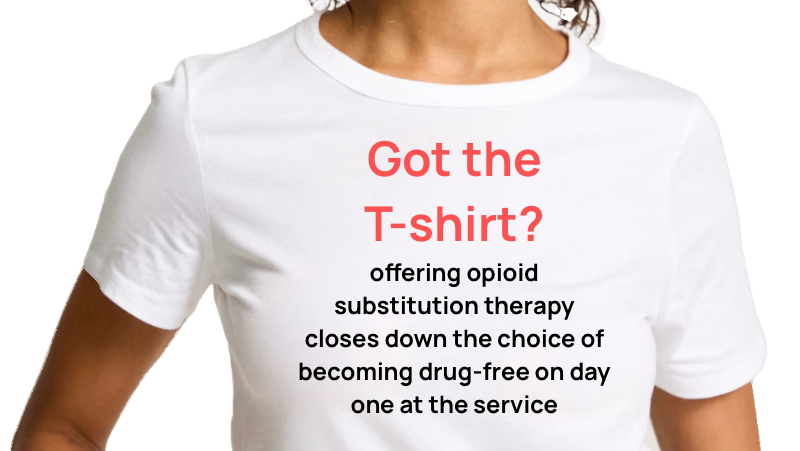
Are you for or against or not sure?
For... When people first come for help, they will be ready to think about a drug free way of life. With the right support and encouragement this can often be achieved and the moment should not be squandered. The advantages of being drug free include all the benefits of opioid substitution and more: life does not revolve around the pharmacy, there are no side-effects of medication, especially from methadone, and there is a chance to restore relationships with children and loved ones.
Against... Opioid substitution is the best way of engaging people in treatment, bringing about some stability by removing the need for drug seeking and its attendant lifestyle. It offers the space to start changing old habits and to embark on a new way of life. Opioid users want a drug effect without the harms: a substitute medication means getting housed, the possibility of work, restoring some relationships, and reducing the risks of overdose, criminal activity, and spreading blood borne viruses.
Here is something to inform your thinking…
Read the summary of this classic review: Despite the well-documented benefits of opioid substitution treatment in treating opioid dependence, many opioid users express a wish to live a drug-free life, however few attempt to come off opioid substitution medications and, of those, few succeed. The aim of this review was to identify the reasons why. Forty one studies were included: USA (22), UK (7), Sweden (6), Canada (1), Ireland (1), Norway (1), Switzerland (1), Australia (1) and China (1).
Eight themes were identified. #1 Psychological: fear of losing the stability that OST provided, fear of losing the support that the service provided, fear of repressed emotions resurfacing, fear of relapse to illicit opioids and fear of withdrawal symptoms. #2 Motivation: low self efficacy and satisfaction with opioid substitution. #3 Withdrawal symptoms: particularly if not stabilised on opioid substitution. #4 Clinical and demographic: poly-drug use and injecting, higher methadone doses, co-occurring mental health problems. #5 Environment: poor housing, unemployment, life pressures and the lack of a drug-free environment. #6 Social: having a personal identity embedded in a drug culture. #7 Professional support: staff frequently do not advocate for detoxification, services are lacking and staff are not qualified to undertake detoxification. #8 Treatment models: effective treatment models, such as variations on community reinforcement, are not available.
Get the full text of the article
Bagshaw A, Shah S, Olchefske I, Paterson LM, Crawford MJ and Lingford-Hughes A (2026) Barriers and facilitators to detoxification from opioid substitution treatment: A mixed-methods systematic review. Addiction pp1-13 https://doi.org/10.1111/add.70482
Have you looked at the Opioid Treatment and Opioid Treatment Outcomes pages and the What is Addiction? page section on Injecting Harms?